
Washington County’s Owner of Record Card
Washington County CAMA labels its current owner field "Account Name." Sometimes a second account-name line appears too. The card also keeps two addresses apart. One shows where the property sits. The other shows where tax notices go. A map number, deed reference, and sales history tie the account to a recorded transfer. Remember what the card is. A tax account is a present administrative record, not a title opinion.
| Account name | The owner label carried on the CAMA tax account |
|---|---|
| Mailing address | Where the Treasurer’s bill or notice is sent |
| Location address | The situs of the Washington County parcel |
| Map number / PRN | Cross-office parcel key and account record number |
| Deed reference | Instrument pointer for the Clerk’s land-record index |
| Sales history | Grantor, price, instrument, and sale date fields |
The name on the owner of record line is not always the person living there. Someone may occupy the property under a lease. A family arrangement can also explain it. No recorded document may mention either one. A mailing address can belong to a trustee, an agent, or a business. Treat it as one field to check on the account. It is not proof of who lives at the situs. It is no guarantee of direct contact either.
Confirming a Washington County Owner Today
Start with the CAMA deed reference or account name. Take it to the Circuit Clerk's land-record index and find the newest deed where the grantee matches the account. Then compare the legal description line by line. Two instruments deserve caution here. A deed of trust is not a transfer, and a release names no new owner. If the instrument is newer than the assessment card, the recorded deed is the better evidence of the current transfer.
- Read the Account Name, map number, and deed reference on the Washington County CAMA card.
- Search the Circuit Clerk’s index for the latest deed to that parcel.
- Compare grantee, date, and legal description with the assessment account.
- If the grantee is an entity or estate, check the relevant Virginia filing or probate record.
- Owner of record
- The party listed on the current tax account or latest deed.
- Grantee
- The party receiving the interest in a deed.
- Situs address
- The property location, which can differ from the owner’s mailing address.
- Recording lag
- The period before a recorded transfer appears on an assessment display; Washington County publishes no fixed number of days.
Reading Washington County Mailing Details
The mailing field shows where the tax notice goes, nothing more. It may point to another town, an agent, or an entity office. Washington County property records serve lawful property questions, and the county's map and assessment pages cannot expose protected addresses covered by a state program.
Lawful use. Use a Washington County owner name and mailing address only for lawful property research or a proper property matter. Do not use the details to stalk, threaten, or harass anyone.
Washington County Current Owner Card Details
A Washington County CAMA card makes a useful model for reading the current account. It lists Bobby P. and Leslie G. Blevins as account names. It lists a mailing address, a location address, map number 159C-A-12E, PRN 42916, and deed D-2002-26490. The fields sit together on one card, yet each means something different. An owner name, a situs, a tax-mail address, and an instrument reference are related facts. They are not the same fact.
None of the sample values say anything about a present-day market price. Use the account name and deed reference to find the current transfer. Then confirm the legal description still matches the parcel. The public portal is a reference display. If a correction is ever needed, the Commissioner's official record controls. The sample Washington County account shows the source fields.
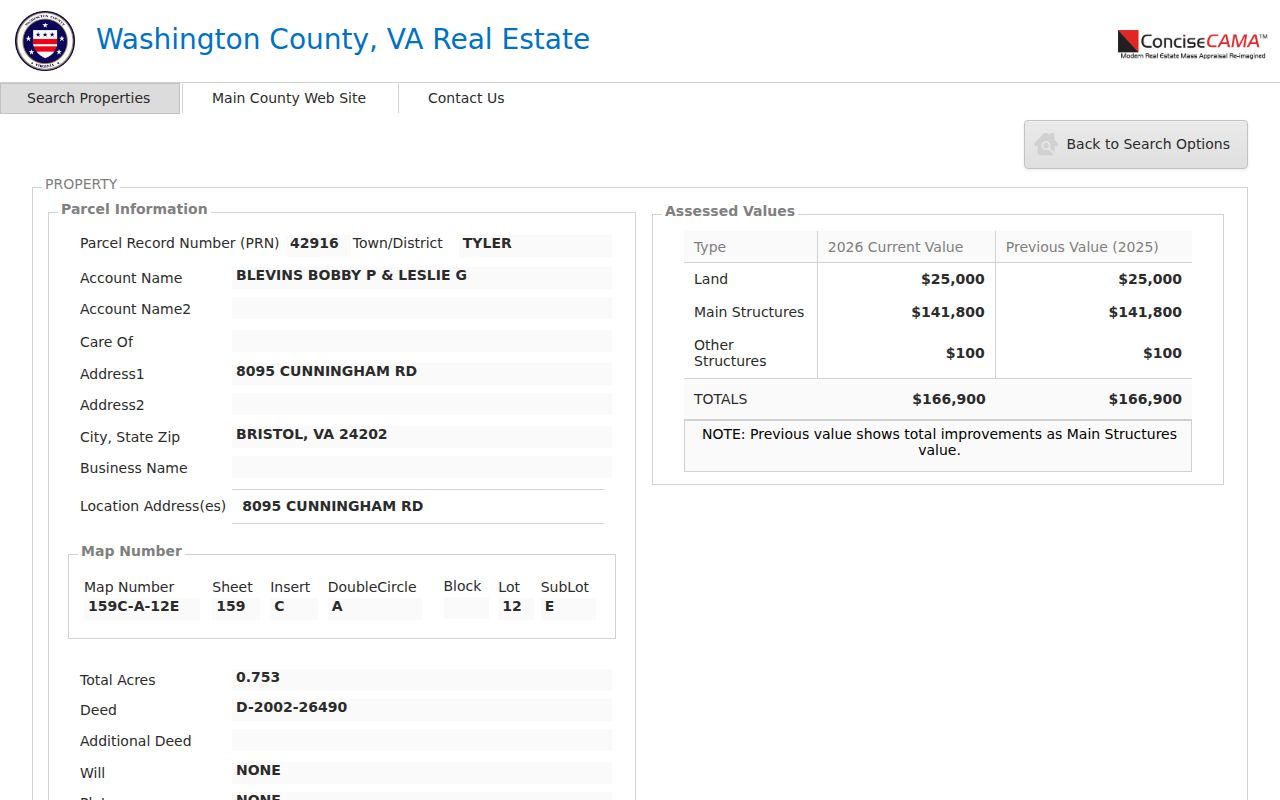
Read the account, mailing, location, and deed reference fields as separate clues about the current owner.
Washington County Owner Data Dates
The CAMA landing page carries a data stamp of September 12, 2026. The sample parcel card reads August 8, 2026. That gap shows why an account can display an older snapshot than its own search page. Washington County publishes no fixed closing-to-roll lag. A recent deed should be compared directly with the latest owner of record field. Do not trust it to catch up on its own.
Write down both dates, the deed recording reference, and the parcel key. If the owner names differ, call the Commissioner. Ask whether the assessment account awaits an update. A blank or older map result may simply reflect the county's roughly 30-day GIS lag for new parcels. It does not mean the deed is missing.
The deed date and the portal update date answer different questions. Keep them side by side when checking who owns a Washington County property now.
Entity Names on Washington County Property
The current owner field can name an LLC, corporation, trustee, trust, executor, or estate. A CAMA account may shorten a name. The recorded deed uses the full grantee or representative role instead. Search the exact name, then compare the deed's legal description and signing capacity. For a company, Virginia SCC CIS shows entity status. It also lists the registered agent, principal office, and filing documents. Open the Virginia SCC Clerk's Information System when the account names a registered entity.
SCC context helps identify the entity, but it does not prove ownership of a parcel. A trust can appear under the trustee, the trust name, or both. An estate can appear through an executor or administrator. Washington County current-owner research should follow the actual recorded instrument. Do not guess at a person behind a legal entity.
The entity lookup adds filing context. The land record remains the source for the transfer itself.
Where Washington County Confirms an Owner
Two offices answer the question. The Commissioner of the Revenue, at the Government Center in Abingdon, holds the tax account. The Circuit Court Clerk keeps the deed index and issues copies. The Clerk works online through SRA/OCRA, and CSC/Simplefile handles recording submissions. Counter visits, mail, and email still work when an online image stays out of reach.
Keep any owner check tight. Four items carry the weight. They are the account name, the latest grantee, the recording date, and the parcel description. Remember that the Clerk does not run a full title examination. The Commissioner's CAMA page also warns that its own records remain authoritative. So a portal result is never an office certification. To walk the full path from an address to a confirmed grantee, see the Washington County owner-finding page.
Washington County Recording Alerts
The Circuit Clerk page advertises Real Estate Document Recording Notifications. The service can flag a newly recorded document. It works by your name or parcel number. The Clerk's office can explain the current sign-up route and how alerts match a record.
Act quickly if an unexpected deed shows up. Compare the grantor, grantee, legal description, and instrument date against the prior deed. Suspected forgery belongs with the Clerk and local law enforcement. An alert only announces an indexed event, though. It cannot cancel an instrument or fix a CAMA account by itself.
Protected Addresses in Virginia Records
Virginia runs an Address Confidentiality Program called Safe at Home. It gives eligible participants a substitute mailing address. A protected location stays out of public-facing records. The program's own rules govern who may apply and how enrollment works. Never treat a blank tax-mail field as a hidden address. Never use public data to defeat someone's safety protections.
CAMA and GIS layers have accuracy limits too. Send any correction to the office that maintains the field. An owner name or mailing address may be legally protected. Ask the records custodian about redaction rather than assuming a missing value is an error. Official details sit at Virginia Safe at Home.