
Values on a Washington County Property Record
A Washington County property record values a parcel in parts. Land, the main building, and other improvements each get their own line. The total appears after that. Dated history entries may show up too. Keep deed records distinct in your mind. A deed reports a conveyance and its stated consideration. The tax roll, though, carries the Commissioner's valuation for assessment. Related sources, different questions.
| Record figure | Meaning | Where to verify |
|---|---|---|
| Land assessment | Assessed value attributed to the land component | County CAMA real-estate account |
| Main improvement | Assessed value of the principal building | County CAMA real-estate account |
| Other improvements | Separate assessed components, when listed | County CAMA real-estate account |
| Account total | Combined assessed components for the value year | Commissioner of the Revenue |
| Deed consideration | Amount shown for a particular conveyance | Circuit Court Clerk land record |
Virginia localities tax real estate on assessed value times the adopted rate. An assessment reflects the county's own valuation process. It is not a price forecast. No buyer is bound to pay the assessed amount. A sale can involve terms, conditions, or partial property interests that push its stated price far from the assessed total.
How to Find a Washington County Property Value
Start with the county's CAMA real-estate portal. It is the practical way into a parcel's assessed components. The public record there can be searched by owner name, street address, or parcel identifier. Begin with the most precise detail you have. Then use the parcel key to confirm a match. That check matters most where addresses are similar or one owner holds several accounts.
- Open the Washington County CAMA real-estate search and select a search method such as owner, address, or parcel.
- Open the matching account and compare the situs address, map number, and parcel number.
- Read the land, main improvement, other improvement, and total fields together.
- Record the account’s update date and the value year before comparing it with a deed or another estimate.
Portal labels change. A street search can return many properties. Use the tax parcel reference rather than guessing from a shortened owner name. The Washington County property search guide maps the rest. To reach a value directly, open the Washington County CAMA property search and pull up the real-estate account and its displayed value fields.
Treat the portal as a reference; the Commissioner's record controls.
A Washington County Value Example by Component
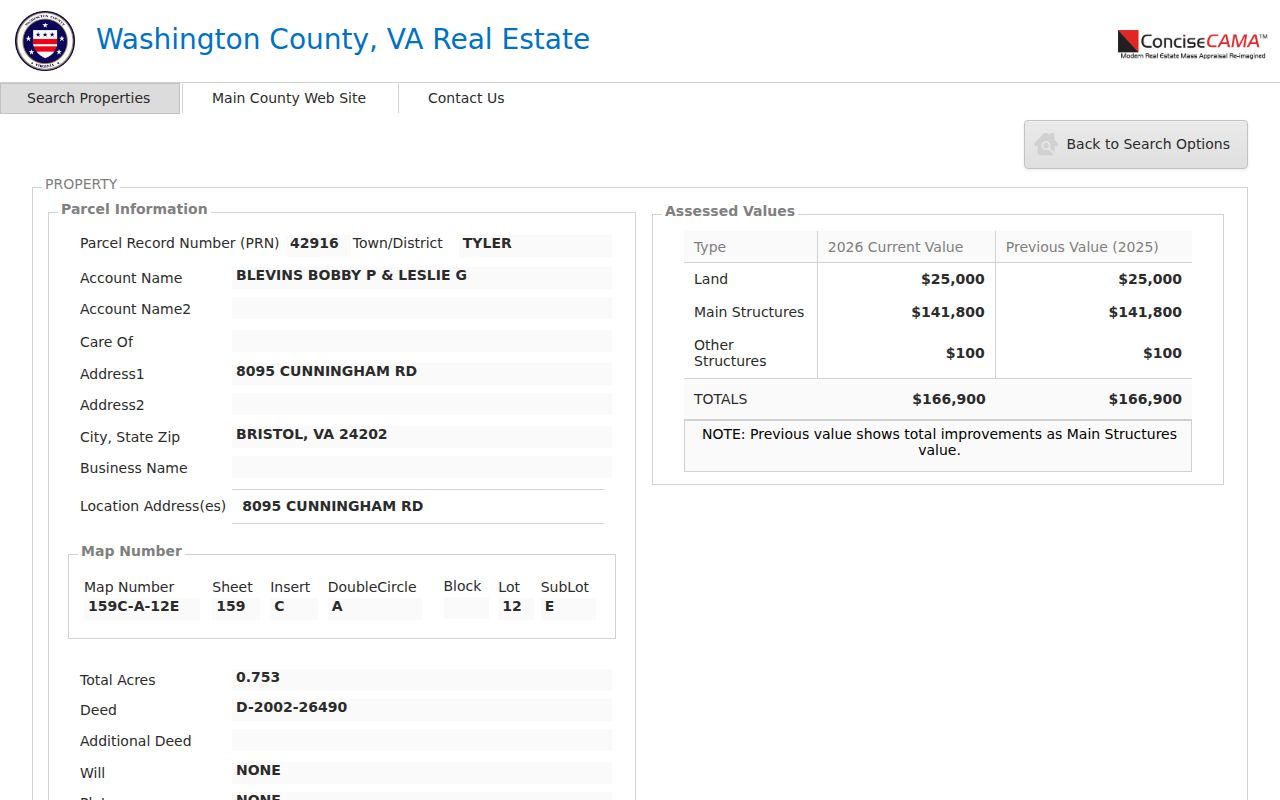
The county's public sample account shows why each component deserves a read. It is more than a single total. Sample PRN 42916 appears with map number 159C-A-12E on 0.753 acres. The 2026 account lists $25,000 for land, $141,800 for the main improvement, and $100 for other improvements. The displayed total is $166,900. Those figures belong to that sample parcel and value year alone. They say nothing about the value of another Washington County property.
Dated history entries sit in the sample too. They include amounts of $68,000 and $0 tied to 2002 dates. Read each history line with its field label and underlying source. Do not assume it is the current assessment or a full sale-price record. For a transfer, go to the deed index and the instrument itself. The Clerk's recording system and the CAMA account are separate public records.
See the Washington County sample parcel account for the value components and account context.
Anchor comparisons with the parcel number and value date.
How Washington County Splits Land and Building Value
The split between land and improvements explains how a total is built. Land is the site itself. The main improvement is usually the principal structure. Other improvements get separate lines. A parcel with several structures therefore shows more detail than a vacant lot. Remember what these lines are. They are valuation categories, not an inventory and not a professional inspection.
Compare the amounts against physical facts. A building may have been remodeled, damaged, torn down, or added since the assessment information was last refreshed. A detached structure may sit elsewhere. If the characteristics or value look off, note the parcel key, the account date, and the exact field. Then contact the Commissioner of the Revenue. The Commissioner holds the official record.
Washington County's CAMA page says its online display is public reference and the Commissioner record controls. Save the account date whenever you file its figures, because an undated snapshot is hard to compare with a later card or assessment notice.
Washington County’s Four-Year Reassessment Cycle
Washington County reassesses real estate on a four-year cycle. That rhythm matters when comparing a CAMA total with listings or new construction. Broad reassessment does not arrive annually. Account details can still change between cycles. The public page may show a data-update date that differs from the effective assessment year.
The county CAMA system displayed an update date of September 12, 2026. A sample parcel card was dated August 8, 2026. Those dates describe the account materials themselves. They do not promise that every property changes on those days. Nor do they mean each field marks a new reassessment. Check the value year and account date printed for the parcel you are researching.
When a sale, addition, or corrected property characteristic is missing from the online account, ask the Commissioner whether the official file has the information. Washington County publishes no fixed closing-to-roll interval. A deed's recording date alone cannot pin down when a change will appear in CAMA.
Compare a Washington County Assessment with a Deed
A deed search can shed light on a property's transfer history. But a recorded amount is not automatically a current market estimate. Weight the transaction date, legal description, parcel key, and instrument type. A parcel may have moved as part of a larger tract, through an estate, or under special terms. Those terms can make the stated consideration a poor comparison with a stand-alone property today.
Use the Clerk's land-record index to locate deeds and related instruments. Then match the parcel description against the CAMA account. If a deed refers to a plat, follow that reference to verify the lot. A transfer recorded after the last assessment cycle can serve as market evidence. Still, the assessment does not automatically equal that deed amount. For deed access and chain-of-title limits, see the Washington County deed-record page.
For a neighborhood comparison, pick properties with similar site area, location, and building characteristics. Match the transaction timing as well. The county GIS can orient a map search. A nearby parcel is not automatically a comparable sale. The county does not establish that CAMA offers a standardized comparable-sales report for every property. So do not assume such a list appears on each account.
Review a Washington County Property Assessment
If a value or property detail looks wrong, start with the parcel account. Name the exact issue: acreage, a building component, an account match, or another field. Gather the map number, PRN, account date, and any supporting deed, plat, or building information. Ask the Commissioner of the Revenue which administrative review path applies. Note that it depends on that property and assessment year.
The county identifies the office and its real-estate forms. However, it sets no single local appeal deadline for all assessments. Virginia tax law includes a 90-day administrative appeal period in applicable situations. That should not be treated as a universal local deadline. Contact the Commissioner promptly to confirm the governing notice, route, and date for the specific assessment. The office's exemption and land-use forms concern separate programs. Their presence does not mean a property qualifies. Nor does it mean a particular deadline applies.
Keep a copy of any submitted request and response. If the issue is really a line location, easement, or legal description, a value review will not settle the boundary question. Use the recorded instrument. Seek professional advice where needed.
Keep Washington County Property Value Separate from Tax Due
The assessed total is one input to the tax calculation. It is not the amount due by itself. Washington County's county real-estate rate is $0.43 per $100 of assessed value. Incorporated towns set separate town rates. The final bill can also hinge on the property's jurisdiction and applicable relief. Other account details can matter too. A bill or payment history lives in the Treasurer's tax system.
For a balance, installment dates, payment methods, penalties, or a delinquent account, check the Treasurer's portal and the Washington County property tax record guide. Keeping valuation research apart from the tax balance helps. It keeps you from treating a payment amount as market value. Do not read a tax rate as an appraisal percentage.
What a Washington County Assessed Value Is Not
A Washington County assessment is a public valuation for local taxation. It is not a licensed appraisal. It is not prepared for a sale, mortgage, insurance claim, estate distribution, or construction decision. The figure can differ from an asking or negotiated price. The four-year reassessment cycle keeps broad valuation updates periodic. Even a fresh account may not reflect a professional inspection of condition. It may not reflect a buyer's particular plans either.
Assessment versus sale value. Treat the public assessment as a tax record and a starting point for questions about the account. For a current transaction or lending decision, obtain an independent valuation from a qualified professional who can inspect the property and state the purpose of the estimate.
When citing a county value, include the parcel key, value year, and the date you viewed the CAMA record. That practice names the exact public figure and gives the custodian a precise account to check if the online display later changes.