
Finding Who Owns a Washington County Property
Address to CAMA account works best. That is the practical route in Washington County. The Commissioner's public CAMA Real Estate Data supports owner-name, address, and parcel searches. Each result shows an "Account Name" for the tax account. It also shows "Location Address(es)" for the site. The map number then ties the account to the same tract in GIS. It links the tract to the deed index as well.
Treat the route as a cross-check. It is not a single-source answer. CAMA labels its display reference data, and the Commissioner's official record controls. A recent deed can run ahead of the assessment roll. A trustee or company may use a different name in each record.
- Search the known situs address or map number in Washington County CAMA.
- Copy the account name, mailing address, parcel key, and deed reference.
- Confirm the latest recorded grantee in the Circuit Clerk’s index.
- If the grantee is an LLC, trust, or estate, check the matching entity or probate record.
- Use the mailing field only as a record contact, not proof of occupancy.
Sources Naming a Washington County Property Owner
Owner information lives in two places in Washington County: the tax account and the land record. CAMA supplies the account name and parcel description. The Circuit Clerk's deed index names the grantee. SCC filings can explain a corporate owner's agent. GIS matches the parcel on the map, but it never controls ownership.
| Source | Owner Info It Gives | Access |
|---|---|---|
| CAMA account | Account name, situs, mailing address, map key | Public reference portal |
| Circuit Clerk index | Grantee and instrument reference | Index access; image access may be restricted |
| Virginia SCC CIS | Entity status, agent, and filing context | Public entity search |
| County GIS | Parcel location and joined map attributes | Public reference viewer |
The owner of record may be a company. It can also be a trustee or an estate. The occupant can be someone else entirely. CAMA's mailing address shows where the tax bill goes, and it can differ from the property's situs. Before a purchase or a parcel-history search, confirm the legal description and the latest deed instead of trusting a nearby name.
Limits of a Washington County Owner Lookup
No lookup proves occupancy or clear title. Nor can it show every beneficial interest. A Washington County owner search has other limits too. CAMA may lag a newly recorded transfer, and an entity name can point to a registered agent instead of someone tied to the parcel. Deeds, court orders, and probate transfers carry context the account field lacks, while privacy statutes and protected-address programs still shield some records.
Lawful use. Use Washington County owner information for lawful property research, due diligence, and civic purposes. Never use a person’s name or address to stalk, threaten, or harass them.
Reading a Washington County CAMA Owner Field
A CAMA account in Washington County holds several name and address fields. Do not collapse them into one. "Account Name" labels the tax account. The mailing address tells where the bill goes. "Location Address(es)" marks the property site, while the map number, acreage, and legal description tie the account to a specific tract.
The card goes further. It also shows a deed reference, sales history, zoning, state class, and separate land and structure values. Those details help you find the right parcel. They do not turn the account into a title certificate. A same-name person or a town mailing label can point to a different property, so check the map key before accepting a match.
The Washington County sample card shows the field layout described here.
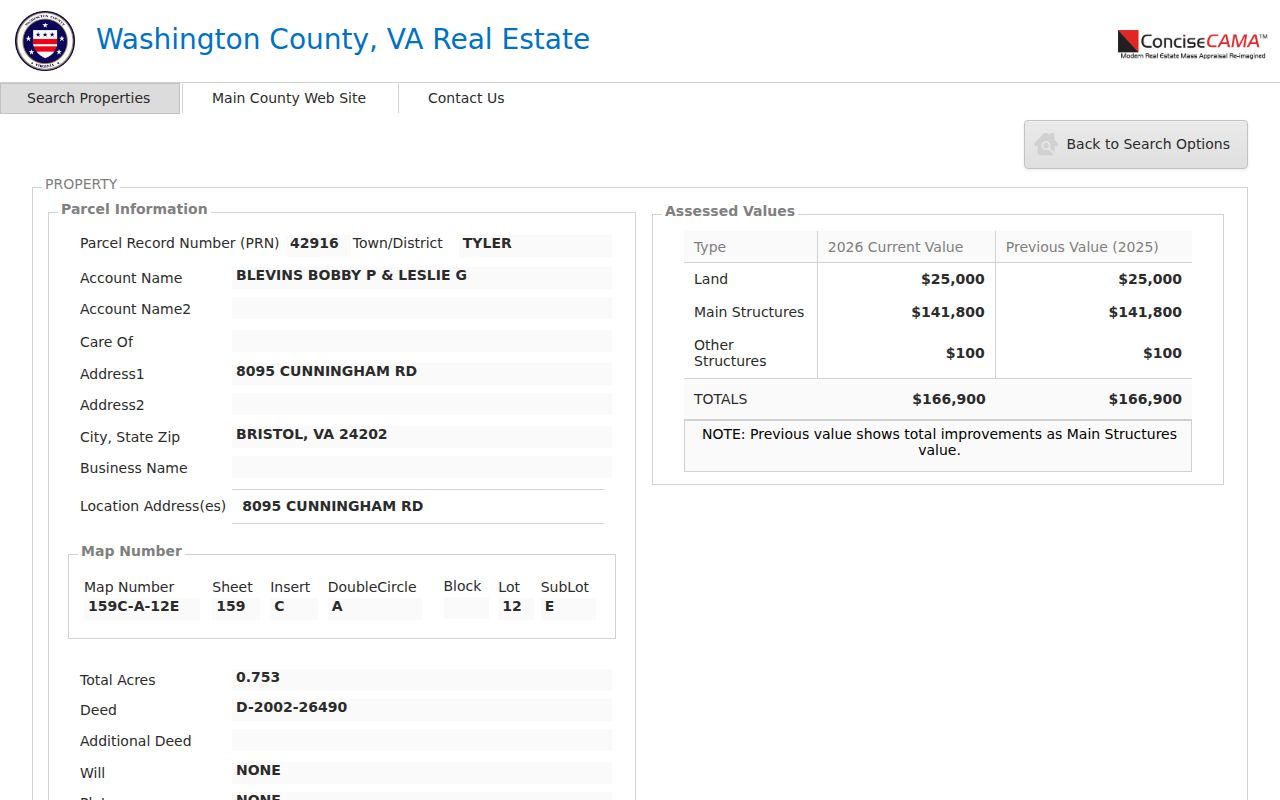
The sample card shows how the county links an account name to a map key. A deed reference sits on the same record.
How Current a Washington County Owner Name Is
Washington County publishes no fixed lag between a deed recording and a CAMA owner update. The deed can be newer. Both may be right for their own update dates. The county posts a data date on the portal and the parcel card. Read both.
After a recent sale, compare the latest grantee in the Clerk's index with the account name. Keep the recording date and the data date. If the names differ, ask the Commissioner whether an update is pending. The Washington County current-owner record section covers that field-by-field check.
Do not treat an older GIS label as a second deed result. GIS updates as corrections arrive. A new lot can take 30 days to appear.
LLCs, Trusts, and Estates in Washington County
A Washington County owner field may name an LLC, corporation, trustee, trust, executor, or estate. Search the CAMA account name as printed. Then compare the deed's grantee. For a business entity, Virginia SCC CIS shows status and registered agent. It also lists the principal office, annual filings, and available documents. That record explains the entity, not the parcel transfer.
Trusts complicate the picture. A trust may be indexed under its own name, the trustee, or both. A life estate can make the account look simpler than the land instrument. Read the instrument itself. An estate may pass property through an executor or administrator deed. Search more than one role. Do not combine records until the parcel description and recording reference match.
The Virginia SCC Clerk's Information System is the public entity-search route. It covers a corporate account name.
The SCC capture supports the entity-name check; the Circuit Clerk remains the source for a land conveyance.
Mailing and Situs Clues in Washington County
Two addresses sit inside every Washington County tax record. The CAMA mailing address tells you where the tax bill travels. That could be a post office box, a trustee, an accountant, or a family member in another state. The situs address is different. It marks the land itself. So a postal town name proves nothing about where the parcel actually lies.
Confusion is common here. E-911 data folds town addresses into one scheme, while rural parcels follow their own numbering pattern. When the mailing city and the physical location clash, line up the parcel boundary, the account, and the deed description before drawing any conclusion. Matching records is the task. Occupancy is a separate question the paperwork cannot answer.
Some Washington County addresses are protected. Virginia's Address Confidentiality Program, Safe at Home, gives eligible participants a substitute mailing address. Follow that program's rules and leave it there. Do not try to reverse a confidential location from other property records.
Washington County Recording Notifications
The Washington County Circuit Clerk advertises a Real Estate Document Recording Notifications service. An owner of record can use it. They learn when a new instrument hits the deed books. The Clerk publishes no confirmed enrollment link or parcel coverage details on the page. Confirm the current service directly with that office. Treat a notification as an early warning, never as a fraud safeguard on its own.
Suspect a forged or unauthorized deed? Contact the Circuit Court Clerk first. Local law enforcement may matter too. Pull the prior deed. Compare grantor, grantee, parcel description, and recording reference against the new instrument. A notice only prompts the review. Resolving the dispute still takes the Clerk's copy and, sometimes, a legal response.
Verify the notification path and current contact details on the official Clerk's service page.
Confirming a Washington County Owner Match
Never trust a name alone. Before you rely on any Washington County owner of record, compare the legal description, the map number, and the deed reference across sources. A CAMA account and a deed sometimes disagree. Check the recording date, then ask the custodian which record was updated more recently. A plat explains a lot layout. A court order or an estate deed explains a name change.
The county's GIS map layer and assessor card are fine starting points. Their disclaimers exist for a reason. A public record can lag or sit incomplete, and an owner field says nothing about who actually lives on the parcel. Keep property records to lawful property questions. High-stakes title matters deserve a professional or the official custodian.
Older names take patience. Walk the deed chain backward deed by deed instead of guessing from a current mailing address.